


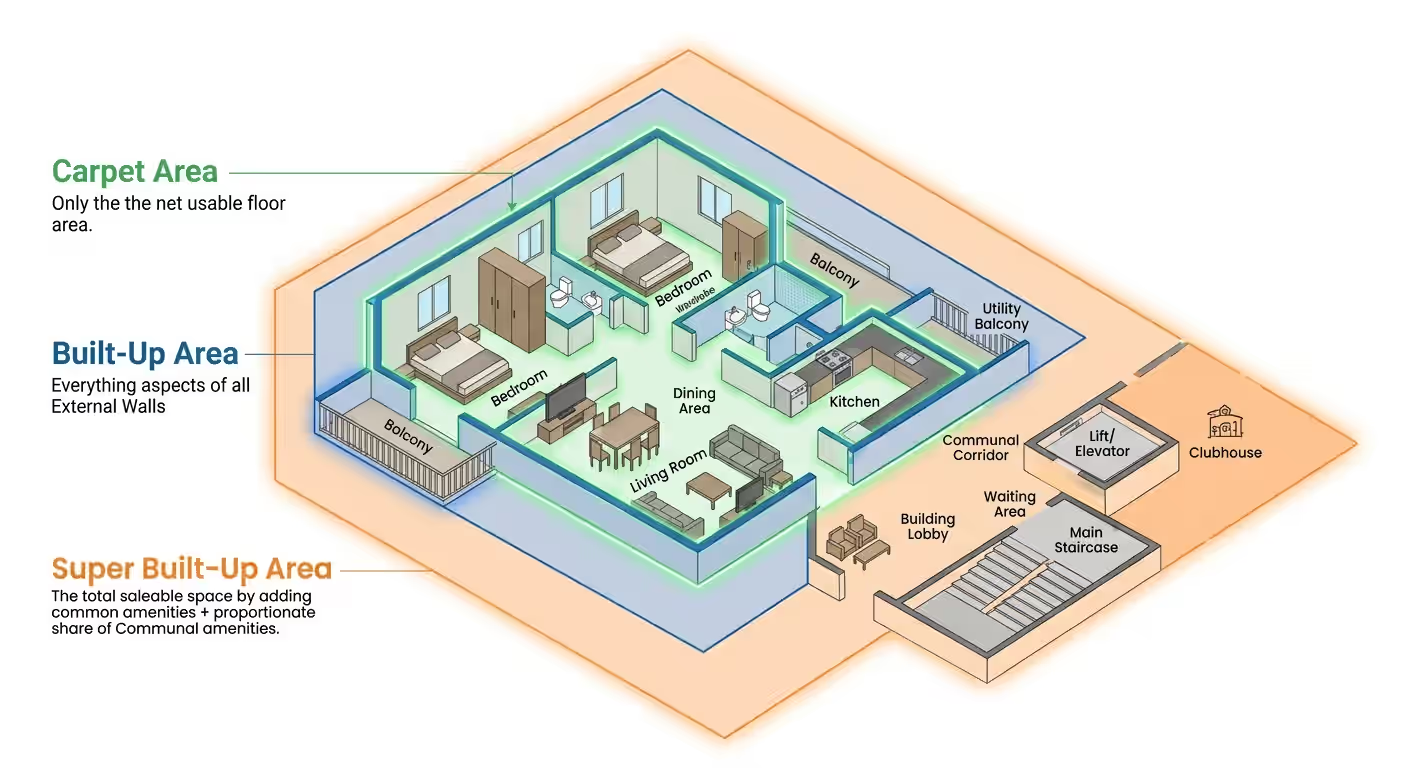
Carpet vs Built-Up vs Super Built-Up Area Explained
You pay for 1,560 sq ft. You live in 1,200.
That 360 sq ft gap isn't a scam, but it isn't free either. It's the difference between what a developer bills and what you actually use. Three terms govern that gap: carpet area, built-up area, and super built-up area. A fourth, UDS, quietly decides your resale value.
Confuse them, and you can overpay by lakhs on a single flat. This is the definitive, no-fluff breakdown every buyer should read before signing.
Quick Snapshot
|
Metric |
What It Measures |
Includes |
Excludes |
Relative Size |
|
Carpet Area |
Net usable floor |
Rooms, kitchen, toilets, inner walls |
External walls, balconies, shafts |
Baseline (smallest) |
|
Built-Up Area |
Physical footprint |
Carpet + wall thickness + balconies |
Common areas |
~10–15% above carpet |
|
Super Built-Up Area |
Saleable space |
Built-up + share of common areas |
Open parking, gardens, water tanks |
~25–40% above carpet |
|
UDS (Land) |
Your share of the plot |
Proportionate undivided land |
The structure itself |
Varies by density |
The golden rule: Carpet < Built-Up < Super Built-Up. Always.
Why This Confusion Costs You Money
Picture two flats. Both advertised at 1,500 sq ft. Both priced at ₹7,500/sq ft. Identical on paper.
But one is quoted on carpet area and the other on super built-up area. The first gives you 1,500 sq ft of real living space. The second might hand you just 1,150 sq ft once you strip out the loading.
Same price tag. 350 sq ft of difference. That's an entire bedroom, vanished into definitions.
This is exactly why understanding these four terms isn't academic. It's the single most profitable hour of research a home-buyer can do.
1. Carpet Area — What You Actually Live In
This is the net usable floor area, the space where you could literally lay a carpet from wall to wall. It's the ground beneath your feet, room by room.
It counts: the floor inside every bedroom, the living and dining space, the kitchen, the toilets, and the inner partition walls that divide them.
It excludes: the thick external walls, service shafts, balconies, and open terraces.
Under RERA (the Real Estate Regulation Act, 2016), this is the legally mandated definition, and the figure every developer must now disclose.
[ Inner Walls ] + [ Rooms ] + [ Kitchen/Toilets ] = CARPET AREA
Why it matters: Post-RERA, carpet area is the only honest unit for comparing two flats. Two projects quoting the same "1,500 sq ft" can differ by 200+ sq ft of real living space once you reduce both to carpet. It is your true yardstick.
2. Built-Up Area — The Physical Envelope
Built-up area is the entire footprint of your apartment, the full physical shell, walls included.
Take the carpet area, then add the thickness of the external walls, the balconies, and the utility ducts attached to your unit. That sum is your built-up area. It typically runs 10% to 15% larger than carpet area.
[ Carpet Area ] + [ Wall Thickness ] + [ Balconies/Utility ] = BUILT-UP AREA
The catch: Wall thickness sounds trivial. It isn't. In a high-rise built with thick structural and shear walls to resist wind and seismic load, the wall-and-balcony allowance alone can consume 12–15% before a single square foot of common area is added.
3. Super Built-Up Area — The Saleable Number
This is the figure developers traditionally bill you for. It's the built-up area plus your proportionate share of common areas: corridors, lobbies, staircases, lift shafts, and the clubhouse.
The grander the shared amenities, the more this number swells.
[ Built-Up Area ] + [ Proportionate Share of Common Areas ] = SUPER BUILT-UP AREA
What it legally cannot include: open parking, common open gardens, and water tanks. If a developer is folding these into your saleable area, that's a red flag worth challenging in writing.
4. Loading Factor — Where Your Money Quietly Goes
The loading factor is the single most important number a buyer ignores. It quantifies the exact gap between what you pay for and what you use.
Loading Factor % = [(Super Built-Up Area − Carpet Area) / Carpet Area] × 100
Benchmark ranges
|
Project Type |
Typical Loading Factor |
|
Standalone apartments |
15% – 25% |
|
Premium high-rise gated communities |
25% – 40% |
Why high-rises load heavier. The more amenities sprawl across a campus, the higher the loading climbs. A G+44 to G+49 premium tower, the class occupied by Hyderabad high-rises like NSL East Luxoria or Rajapushpa Sierra, bundles sky lounges, infinity decks, multi-level lobbies, banks of high-speed elevators, and acre-scale clubhouses.
Every one of those shared square feet is divided across the towers and added to your saleable number. That's why a sprawling, amenity-rich community can push loading toward the top of the 25–40% band, while a no-frills standalone block stays near 15%.
A note on precision: Exact loading factors are project-specific and shift with tower layout and amenity scale. Always pull the actual carpet-vs-saleable figures from the project's RERA filing, never trust a brochure's rounded number.
5. UDS — The Land Beneath Your Flat
Here's the term that decides your long-term wealth: the Undivided Share of Land (UDS).
A flat is two assets stacked together: the structure (which depreciates) and the land (which appreciates). UDS is your slice of that land, the proportionate plot allotted to your apartment, held jointly with all other owners, without physical demarcation.
UDS = (Your Flat's Saleable Area / Total Saleable Area of All Flats) × Total Land Area
Why it's decisive:
• Resale & appreciation: the land component drives long-term value. A higher UDS means a larger appreciating asset.
• Redevelopment payout: when a building is eventually torn down and rebuilt, compensation is calculated on UDS, not on your carpet area.
• Density signal: tall, dense towers spread the same plot across hundreds of flats, shrinking each owner's UDS. Low-rise projects often carry a richer land share per flat.
Buyer rule: A glittering G+49 tower can carry a thinner UDS than a modest G+5 block on a generous plot. Ask for the UDS in writing, it never appears in the glossy brochure, but it's written into your sale deed.
The Math, End to End
Here's how a single flat moves through every definition.
|
Stage |
Calculation |
Area |
|
Carpet Area |
Baseline usable space |
1,200 sq ft |
|
Built-Up Area |
+12% (walls + balconies) |
1,344 sq ft |
|
Super Built-Up Area |
Carpet × 1.30 (30% loading) |
1,560 sq ft |
Loading factor:
(1,560 − 1,200) / 1,200 × 100 = 30%
Now apply price. At a quoted ₹7,000 per sq ft on super built-up, you pay:
• Billed: 1,560 × ₹7,000 = ₹1.09 Cr
• True cost per usable (carpet) sq ft: ₹1.09 Cr ÷ 1,200 = ₹9,100/sq ft
That ₹7,000 headline rate is really ₹9,100 for the space you live in. Always re-price on carpet to compare two projects honestly.
Carpet vs Super Built-Up: Side by Side
|
Question |
Carpet Area |
Super Built-Up Area |
|
What is it? |
Space you live in |
Space you're billed for |
|
Mandated by RERA? |
Yes |
Disclosure only |
|
Includes common areas? |
No |
Yes |
|
Includes balconies? |
No |
Yes (via built-up) |
|
Best for comparing flats? |
Yes |
No |
|
Best for negotiating price? |
Yes |
No |
Takeaway: Developers sell on super built-up. Smart buyers negotiate on carpet.
The RERA Lens
Before 2016, developers sold purely on super built-up area with zero standardisation, buyers had no fixed yardstick and no recourse. RERA changed the contract.
Carpet area is now the mandatory disclosed unit. Quoting only super built-up area without the carpet figure is non-compliant. RERA also requires registered projects to publish approved plans and timelines on the state RERA portal.
This doesn't ban loading, it makes it transparent. Your job as a buyer is simply to read past the saleable number to the carpet figure underneath.
6 Red Flags to Watch For
• No carpet area disclosed. It's your legal right. Silence is a warning.
• Open parking loaded into super built-up. Not permitted. Push back.
• Loading factor above 40% without exceptional amenities to justify it.
• UDS withheld or described as "not applicable." It always applies.
• "Saleable area" used vaguely without a carpet breakdown alongside.
• Brochure figures that don't match the RERA filing. The filing wins, every time.
Buyer's Checklist
• Demand carpet area in writing, it's your legal right under RERA.
• Compute loading yourself using the formula. Don't accept the developer's word.
• Re-price on carpet before comparing any two projects.
• Ask for the UDS and check it against the sale deed.
• Challenge inflated commons, parking and gardens cannot sit in super built-up.
• Cross-verify against the RERA filing, not the marketing brochure.
Frequently Asked Questions (FAQ)
Q1. What is the difference between carpet area and super built-up area?
Carpet area is the net usable floor space inside your flat (rooms, kitchen, toilets, inner walls). Super built-up area is that same space plus a proportionate share of common areas like lobbies, lifts, and the clubhouse. Super built-up is always larger, usually by 25–40% in premium high-rises.
Q2. Is RERA carpet area the same as usable area?
Effectively, yes. RERA carpet area is the legally defined usable floor area, including inner partition walls but excluding external walls, balconies, and shafts. It is the truest measure of the space you live in.
Q3. Why do I pay for super built-up area when I only get carpet area to live in?
Because you also use shared infrastructure: lobbies, staircases, lifts, and amenities. The cost of building and maintaining those is distributed across all owners and shows up as the loading factor on your saleable area.
Q4. What is a good loading factor?
For standalone apartments, 15–25% is normal. For premium, amenity-rich high-rises, 25–40% is typical. Above 40% is steep and should be justified by genuinely extensive shared facilities.
Q5. Can a developer charge me for open parking in the super built-up area?
No. Open parking, common open gardens, and water tanks are legally excluded from super built-up area. If they appear in your billed area, challenge it in writing.
Q6. How do I calculate the true price per square foot?
Divide the total flat cost by the carpet area, not the super built-up area. A flat billed at ₹7,000/sq ft on super built-up with 30% loading actually costs around ₹9,100 per usable carpet sq ft.
Q7. Does built-up area include the balcony?
Yes. Built-up area includes the carpet area plus external wall thickness, balconies, and utility ducts, typically 10–15% more than carpet area.
Q8. What is UDS and why does it matter?
UDS (Undivided Share of Land) is your proportionate, undivided share of the project's land. It drives long-term appreciation and decides your compensation if the building is ever redeveloped. Dense high-rises usually carry a smaller UDS per flat.
Q9. Is a higher loading factor always bad?
Not necessarily. Higher loading often buys richer shared amenities: clubhouses, sky decks, fast lifts. The mistake is paying premium-tower loading for standalone-tower facilities.
Q10. How do I convert super built-up area back to carpet area?
Use the loading factor: Carpet Area = Super Built-Up Area / (1 + Loading Factor). For a 1,560 sq ft flat at 30% loading: 1,560 ÷ 1.30 = 1,200 sq ft carpet.
The AssetScan Verdict
These terms aren't interchangeable jargon, they're a hierarchy that costs real money.
Carpet area is truth: the space you own and occupy. Built-up area is the physical shell. Super built-up area is the developer's billing unit, inflated by a loading factor that runs from a lean 15% in standalone blocks to a heavy 40% in amenity-dense G+44-plus towers. And UDS is the quiet long game, the appreciating land beneath it all.
Neither high nor low loading is inherently "bad." A 35% loading buys you sprawling clubhouses, sky decks, and fast lifts, if you value them. A 17% loading gives you more wall-to-wall flat per rupee, with thinner shared luxury. The mistake is paying premium-tower loading for standalone-tower amenities.
Bottom line: Never compare two projects on super built-up area. Strip both back to carpet, recompute the per-square-foot cost, check the UDS, and let the real numbers decide. That single discipline is worth lakhs.
Always verify every area figure, carpet, super built-up, and UDS, against the official RERA filing and your sale deed before any transaction.
Sources & References
Primary legal & regulatory sources
• The Real Estate (Regulation and Development) Act, 2016 — Section 2(k) (statutory definition of carpet area), Section 4 (mandatory disclosure), and Section 13 (pricing on a carpet-area basis). Official full text via India Code (Govt. of India): indiacode.nic.in/handle/123456789/2158
• Telangana Real Estate Regulatory Authority (TG-RERA) — official portal to verify a project's registration, approved plans, and carpet-area disclosures: rera.telangana.gov.in
• Haryana RERA Gazette Notification — regulatory clarification that apartments must be sold on a carpet-area basis and that vague "super area" definitions are discouraged: haryanarera.gov.in (Carpet Area regulation PDF)
• State RERA portals (general): each state maintains its own RERA authority and project-search portal. Verify any project on the RERA portal of the state where the property is located.
Note on figures used in this article
• The statutory definition of carpet area is sourced directly from Section 2(k) of RERA, 2016 (above).
• Built-up and super built-up area are not defined under RERA; they are industry terms. The descriptions here reflect standard market usage.
• The loading factor benchmarks (15–25% standalone, 25–40% premium high-rise) and the 10–15% built-up uplift are general industry conventions, not statutory figures. Actual values vary by project and must be confirmed against the specific project's RERA filing.
• UDS is governed by the applicable State Apartment Ownership Act and recorded in the registered sale deed; confirm the exact figure in your conveyance documents.
• Worked examples (e.g., the 1,200 / 1,344 / 1,560 sq ft flat) are illustrative and chosen for arithmetic clarity, not drawn from any specific project.
Disclaimer: This article was written with the assistance of AI and is intended for general informational and educational purposes only. It does not constitute legal, financial, or investment advice. Area definitions, loading benchmarks, and regulatory references are illustrative and may vary by state, project, and developer. Always verify figures against the official RERA filing, the sale deed, and a qualified legal or financial advisor before making any property decision.

